Auger has been recognized by Gartner in Coolest Vendor Innovations in Supply Chain Planning Technology, 2026 for the Autonomous Supply Chain OS. The report profiles three vendor innovations that Gartner identifies as enabling autonomous decision making for heads of supply chain planning.*
From the Gartner Report
To us, the report’s premise matches what we hear in every operations review: legacy supply chain planning systems fail in volatile and uncertain environments. From our perspective, Gartner frames the shift as a pivot away from static, periodic S&OP toward decision orchestration, continuously evaluating trade-offs, synchronizing decisions across functions, and adapting plans as conditions change.
In our opinion, Gartner calls that shift decision orchestration. We call it autonomous planning and execution, divided by horizon rather than by ritual, so the plan and the work that runs on it stay in one system.
What Auger actually is
Where visibility tools add another view of the business, Auger is a multi-layer platform for autonomous planning and execution that sits above the systems you already run. It integrates your data, operating rules, and operator knowledge into one executable ontology: a live model of how your business actually runs, not another dashboard on a data lake. It works on your data in its existing state, so no multiyear cleanup gates the start.
Optimization calculates the feasible choices and what each one costs. Agents work the situation against the model and the math, then act inside the authority you delegate or bring the analysis to your team. Authorized changes go back to your systems of record, and what actually happened comes back.
The five parts, in order
01
ONTOLOGY
The connected model of your operations and rules: orders, inventory, capacity, sites, lanes, customers, and the constraints that govern them.
02
OPTIMIZATION
A supply chain is coupled optimization problems, each solved in isolation inside the system that owns it. Coupling them makes the output of one a constraint on the next.
03
AGENTS
The reasoning layer. Agents work the situation against the model and the math, then act inside delegated authority or elevate with the analysis attached.
04
EXECUTION
One decision endpoint, two authorization paths: execute inside delegated policy, or elevate for signature and execute on approval.
05
LEARN
Expected against actual on every executed decision. That record is the accuracy evidence and the basis for widening authority.
How queries resolve deterministically against the ontology, and how each layer is built, is on the Platform page.
What the Coordination Tax costs
Most supply chain software tells your people what needs doing. Auger does it, inside the authority you delegate.
A supplier misses at four in the morning. Five teams each hold part of the trade-off, so the decision becomes a week of meetings. Consensus comes out, and because nobody in the room is paid to lose, you get the answer nobody objected to rather than the best one. That is the Coordination Tax. At one manufacturer it cost $12.5 million a year.
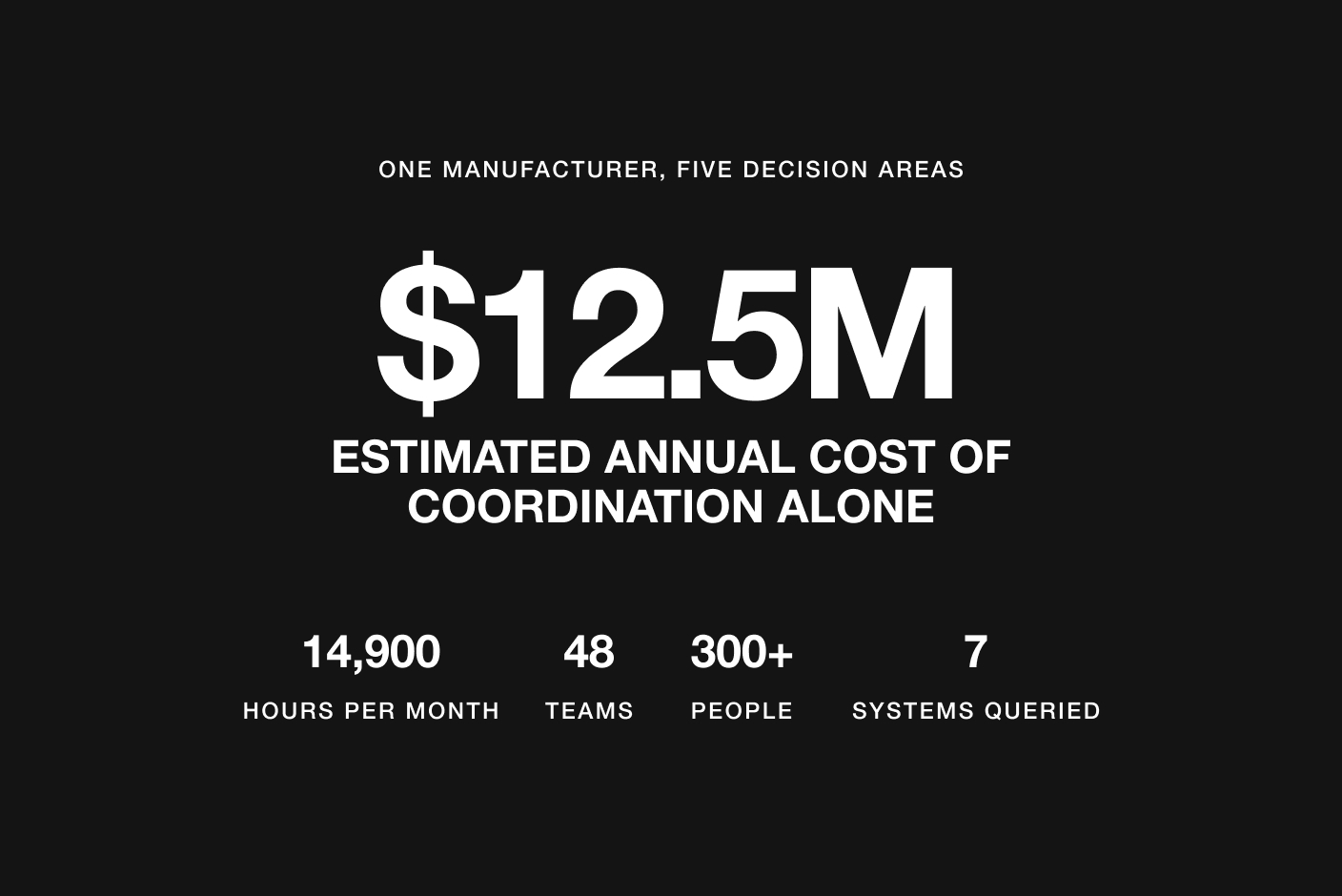
Look at what actually produces those five decisions. None of them comes out of a system. Every one comes from a group of people, their spreadsheets, and a recurring meeting. Humans doing integration work between systems that do not talk to each other. That is the Human API, and the $12.5 million is what it costs to run.
The symptom is decision latency: a decision that arrives after it could have changed anything. Auger reasons across the trade-off, executes inside the authority you delegate, and writes the decision back. Anything that needs elevation reaches a person with the analysis already done, the same day.
SYSTEMS
NO RIP-AND-REPLACE
Auger writes decisions back to ERP, TMS, and WMS rather than displacing them. Nothing gets ripped out. The systems you already run coordinate for the first time. Auger runs on Microsoft Azure as Microsoft’s premier supply chain partner on Microsoft Fabric.
AUTHORITY
AUTONOMY IS A DIAL, NOT A SWITCH
Advance a decision type from recommendation to autonomous action as the expected-against-actual record earns it. You set what Auger does on its own, the limits it stays inside, and which calls always come to a person. The judgment stays yours. The chasing stops.
What it does in production
One of our customers runs Auger across its print and embellishment network. Auger evaluates facility capacity, customer commitments, and transportation together to select the lowest cost feasible fulfillment option, then checks assignments against actual conditions each day. It operates autonomously across millions of units a week, saving millions annually and capturing sales previously lost to delay.
Auger is trusted by Meta Reality Labs, Fanatics, Kimberly-Clark, and Owens & Minor, and has raised $150 million across two rounds.
What you can audit
Generic agent stacks sell intelligence. Auger sells a labor force that a CISO can mark, a CFO can meter, and a chief supply chain officer can audit. Every write carries identity, cost, lineage, and an authorization gate.
Foundation models get cheaper every year and everyone gets the same ones. The model of how your business actually runs is yours alone, it compounds, and nobody can buy it. You are not renting your own decisions back by the token.
Where to start
Choose the package of autonomy that fits the work you want Auger to take on.
Order Fulfillment
Build
Supply Assurance
Launch
We map how the work runs today, then show the same process once Auger runs it. What runs on its own, what comes to a person, what disappears. First production value lands in 16 to 24 weeks, depending on complexity.
WhAT WE MEASURE, AGAINST YOUR BASELINE
Capacity returned to your people. Sales captured that would otherwise be lost. Customer promises kept. Cash released from inventory. Operating costs reduced.